

A personal injury file can contain hundreds or thousands of pages: emergency department notes, imaging reports, operative records, physical therapy notes, specialist consultations, medication records, and bills. The challenge is not simply finding information. It is understanding what happened, when it happened, how the patient progressed, and which facts matter to the legal theory of the case.
A well-prepared medical chronology becomes a litigation roadmap. By arranging clinically relevant events in date order and tying each event to its source record, it helps an attorney see the story of an injury without repeatedly reconstructing it from disconnected documents.

What Is a Medical Chronology?
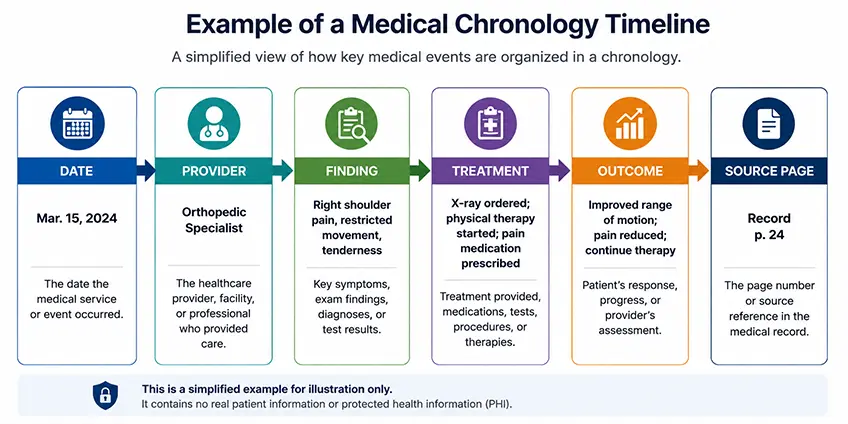
A medical chronology is a structured, date-sequenced account of a patient's medical care. It typically captures the date of service, provider and facility, presenting complaints, diagnoses, diagnostic testing, treatment, medications, procedures, clinical outcomes, and other facts relevant to the claim. A strong chronology does not replace the underlying records; it makes the underlying records easier to navigate and analyze.
LinksToValue's Medical Chronology Services are designed around this principle. Its current service description emphasizes chronological sequencing, provider information, diagnoses and treatment, clinical outcomes, billing summaries, and hyperlinked citations or bookmarks that allow users to move from a summarized event to the corresponding source page.
1. It Establishes a Clear Injury-to-Treatment Timeline
In many personal injury matters, timing is central. What symptoms appeared immediately after an accident? When did the claimant first seek care? When were diagnostic tests ordered? When did conservative treatment fail? When did surgery, injections, therapy, or specialist care become necessary?
A chronology places these events on one timeline. That helps counsel evaluate the temporal relationship between the incident and the documented medical response without relying on memory or scattered notes. It can also make the progression of care easier to explain during settlement discussions, depositions, mediation, or trial preparation.
2. It Helps Separate the New Injury From the Pre-Injury Record
Pre-existing conditions are a routine issue in personal injury litigation. A claimant may have prior back pain, degenerative findings, an earlier surgery, or unrelated chronic conditions. The key question is often not whether the condition existed before the incident, but what changed afterward.
A chronology that reaches far enough back into the record can create a before-and-after picture: baseline symptoms and function, the incident, immediate complaints, objective findings, treatment escalation, and subsequent functional limitations. That structure gives the attorney a better factual foundation for investigating causation rather than treating every diagnosis in the chart as part of the same injury.

3. It Exposes Treatment Gaps and Missing Records
A gap in treatment can become a question about severity, causation, compliance, or damages. But a gap in the chronology does not automatically mean a gap in care. Sometimes the missing information simply has not been retrieved.
Systematic chronology preparation can flag unexplained intervals, referrals mentioned but not followed by corresponding records, imaging referenced without the report, or procedures appearing in billing data without supporting clinical documentation. That gives the legal team an opportunity to investigate the gap while there is still time to obtain the missing material.
For firms that need help closing those gaps Medical Record Retrieval Services can complement chronology preparation by helping build a more complete underlying record set.
4. It Makes Inconsistencies Easier to Find — and Explain
Medical records are created by different providers, specialties, and electronic health record systems. Symptoms may be described differently from visit to visit. Dates may appear in different formats. Copy-forward entries can preserve outdated information. Billing codes may not immediately match the language in a clinical note.
A chronological view makes these discrepancies visible because related events sit next to one another. The goal is not to manufacture a contradiction where none exists. It is to identify questions early: Is this a genuine inconsistency? Is there a documentation artifact? Is another record needed to resolve it? A structured chronology helps counsel answer those questions before opposing counsel does.
5. It Supports More Accurate Damages Analysis
Medical damages are not just a collection of bills. The legal team may need to understand what treatment was provided, why it was provided, how the patient's condition changed, whether treatment remains ongoing, and what future care may be documented or anticipated.
When clinical events and billing information are organized together, attorneys can more readily compare treatment against charges and identify the medical events that underpin economic damages. LinksToValue's chronology service, for example, describes inclusion of billing summaries alongside clinical information, which can help create a more usable case record.
6. It Gives Attorneys a Better Tool for Depositions, Mediation, and Trial Preparation
A chronology can reduce the cognitive load of preparing for a deposition or settlement conference. Instead of repeatedly searching through the source file to reconstruct the sequence of care, counsel can start with a date-ordered roadmap and then drill down into the original records for verification.
That is particularly valuable when the medical history spans multiple specialties or years of treatment. A chronology can help attorneys formulate focused questions, identify pivotal encounters, prepare exhibits, and explain the treatment narrative to clients, experts, adjusters, mediators, or jurors.
A medical chronology can help attorneys organize the facts needed when drafting demand letters, preparing for depositions, or developing case strategy.
7. It Turns Medical Volume Into Case Strategy
The real value of a chronology is not the number of pages it saves. It is the clarity it creates. A well-organized chronology can help the legal team identify the strongest evidence, the weakest links, unanswered questions, missing documentation, and issues that deserve expert attention.
This is why chronology work is most useful when it sits within a broader medical-record workflow: retrieve the records comprehensively, review them systematically, organize the clinically relevant facts, and preserve a clear path back to the source documentation. LinksToValue describes this combination through its Medical Record Retrieval, Medical Record Review, and Medical Chronology services.

A Practical Workflow for Small and Mid-Sized Personal Injury Firms
- Start with complete retrieval. Build a provider list from every record, referral, bill, and diagnostic reference encountered.
- Review before summarizing. Identify injury mechanism, prior conditions, causation clues, treatment progression, gaps, inconsistencies, and damages-related information.
- Build the chronology in date order. Capture only facts that are clinically or legally relevant, while preserving source-page references.
- Flag questions, not conclusions. Mark missing records, conflicting entries, unclear causation language, and unexplained treatment gaps for attorney review.
- Use the chronology as a working map. Return to the original records when preparing demands, depositions, expert materials, mediation statements, or trial exhibits.
For firms managing large litigation files, Legal Coding and Indexing Services can help organize documents and make relevant records easier to locate during case preparation.
Why Medical Chronology Matters
For a busy personal injury practice, medical records should not be a maze that the attorney has to solve from scratch every time a case milestone arrives. A disciplined chronology converts a fragmented treatment history into a navigable evidence trail. It helps counsel see sequence, change, gaps, inconsistencies, and supporting documentation in one place.
The chronology is not the argument; it is the factual map that helps the attorney build it. When accurate, source-linked, and complete, it lets the legal team spend less time reconstructing medical history and more time deciding what the evidence means for liability, causation, damages, negotiation, and trial strategy.
For US personal injury firms looking to strengthen this workflow, explore LinksToValue's Medical Record Review, Medical Chronology Services, and request a free sample review to see how the process can fit your firm's case-management workflow.
These services support firms handling personal injury and other litigation matters across multiple practice areas. Explore our Areas of Expertise to see where LinksToValue provides litigation support.
Important Note
This article is intended for general informational and litigation-support purposes. It is not legal advice, medical advice, or a substitute for review by licensed counsel and qualified medical professionals. Evidentiary and procedural requirements vary by jurisdiction and case.
FAQs
A medical chronology is a structured, date-ordered summary of clinically and legally relevant medical events. It typically records providers, dates of service, symptoms, diagnoses, testing, treatment, procedures, medications, outcomes, and source references.
It gives the attorney a clear roadmap of the patient's treatment history, making it easier to evaluate causation, treatment progression, damages, gaps in care, inconsistencies, and the relationship between the incident and subsequent medical events.
Yes. A chronology can highlight unexplained intervals between visits, referrals without corresponding records, missing diagnostic reports, or other breaks in the documented treatment sequence. The attorney can then determine whether the gap reflects missing records or an actual interruption in care.
By organizing records from before and after the incident, a chronology can help counsel compare the claimant's documented baseline with subsequent symptoms, findings, treatment, and functional changes. It does not make a legal causation determination, but it creates a clearer factual record for that analysis.
Yes. A chronological, source-linked roadmap can help counsel locate pivotal encounters, formulate focused questions, verify dates and treatment, and explain the medical narrative without repeatedly reconstructing it from a large record set.
Medical record review is the broader process of examining and analyzing the underlying records for relevant facts, issues, inconsistencies, gaps, and other case information. A medical chronology organizes the relevant medical events into a clear sequence that attorneys can use as a working case roadmap.
Outsourcing can be useful when record volumes, deadlines, or staffing constraints make in-house review difficult. A qualified provider can give a small or mid-sized firm structured chronology support while allowing attorneys and paralegals to focus more time on legal strategy and client work.
Reviewer / Attribution
Reviewed by: Sugeet Wahal — Founder & CEO, LinksToValue
Sugeet Wahal is the Founder & CEO of LinksToValue, a legal process outsourcing company supporting US law firms with medical record review, medical chronology, and related litigation support services. His professional focus includes helping legal teams turn complex medical documentation into organized, litigation-ready information.
LinkedIn: https://www.linkedin.com/in/sugeetwahal/