

Insurance adjusters don’t settle claims on adjectives. They settle on evidence: diagnosis codes, objective findings, treatment duration, and a defensible line between the incident and the injury. A personal injury demand letter that simply lists providers and totals the bills hands the adjuster an easy reason to discount. One that traces the injury from the first emergency room note to the final prognosis, with every assertion tied to a Bates-stamped page, leaves far less room to argue.
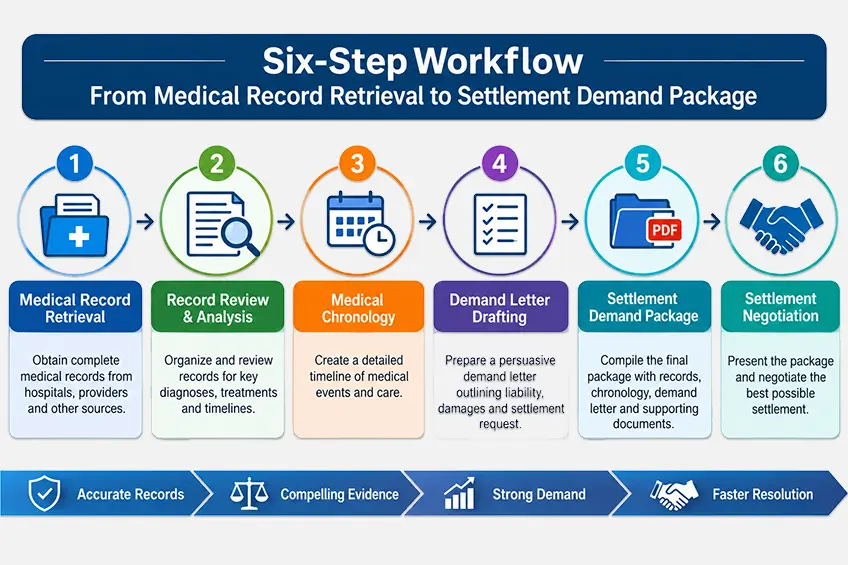
This guide shows how to draft an effective personal injury demand letter by following the workflow behind it: how medical records move from retrieval to review, from chronology to narrative, and finally into a settlement demand package that holds up under scrutiny.
Why the Medical Narrative Decides the Value of the Demand
In most personal injury claims, liability is only half the conversation. The value of the claim lives in the medical evidence. Adjusters, and the claims-evaluation software many carriers use, weigh the type and severity of diagnoses, objective test results, the length and consistency of treatment, and anything suggesting the injury came from somewhere else. Treatment gaps, unexplained prior complaints, and inconsistent pain reporting are where offers get cut. Thorough medical record research means finding those weak points before the adjuster does.
Step 1: Retrieve a Complete, Defensible Record Set
A narrative is only as strong as the records behind it. Request records and itemized bills from every provider in the treatment path: EMS run reports, emergency department notes, primary care, specialists, imaging centers, physical therapy, chiropractic, and pharmacy. Request facility (UB-04) and professional (CMS-1500) billing alongside clinical records so the damages figures reconcile later.
Equally important are prior records for the same body parts, typically covering several years before the incident. Defense counsel will request them anyway; reviewing them first lets your team frame an aggravation argument instead of reacting to one. A structured medical record retrieval process, with HIPAA-compliant authorizations, request tracking, and follow-up on outstanding providers, prevents the most common delay in demand preparation: waiting on one missing chart.
Step 2: Review and Organize Before Anyone Writes

Raw records are not evidence until they are organized. Bates-stamp every page, remove duplicates, and sort by date and provider. Then review with the demand in mind, flagging:
- Mechanism of injury as recorded at intake, and whether it matches the incident report
- First documented complaints for each body part
- Objective findings from MRI, CT, X-ray, and EMG/NCS studies
- Physician statements on causation, work restrictions, and permanency
- Gaps in treatment and any documented reasons for them
- Prior complaints or treatment involving the same body part
- Future care recommendations such as surgery, injections, or ongoing therapy
A focused medical record review surfaces both the strengths to lead with and the vulnerabilities to address head-on.
Step 3: Turn the Medical Chronology Into a Narrative
A medical chronology is the backbone of the demand. Each entry should capture the date, provider, presenting complaints, clinical findings, diagnoses with ICD-10 codes, procedures with CPT codes, the treatment plan, and a page citation back to the source record.
The chronology is the research; the narrative is the argument. Compare two ways of describing the same treatment (illustrative example):
- List: "Client attended 24 physical therapy sessions."
- Narrative: "Over 12 weeks of physical therapy, the claimant’s lumbar range of motion improved only partially; the discharge note (Bates 0412) documents a continued inability to lift more than 15 pounds, consistent with the L4–L5 disc protrusion confirmed on MRI (Bates 0187)."
The second version links a functional limitation to an objective finding and gives the adjuster a page to verify it.
Step 4: Address Causation and Weak Points Directly
An effective demand does not hope the adjuster misses a problem. If the claimant had pre-existing low-back complaints, use the prior records to show a stable baseline and the post-incident change, which is the foundation of an aggravation claim. If there is a six-week gap in treatment, explain it with documentation, whether an insurance lapse, a scheduling backlog, or a physician-directed home exercise period. Where treating physicians have commented on causation, quote them with citations. Unexplained gaps get filled with the adjuster’s own assumptions.
Step 5: Quantify Damages With a Paper Trail
Economic damages (specials) should reconcile line by line with the billing records: past medical expenses, lost wages verified by employer statements or tax records, out-of-pocket costs, and projected future care drawn from physician recommendations or a life care plan. Whether billed or paid amounts are presented depends on the governing state’s collateral source and evidentiary rules, a decision for the responsible attorney.
Non-economic damages (generals) are stronger when anchored in the records rather than adjectives. Physical therapy notes on lifting limits, sleep disruption recorded by a primary care physician, and psychological referrals all document how the injury changed the claimant’s activities of daily living.
Step 6: Assemble the Settlement Demand Package
A well-structured personal injury settlement demand letter typically follows a clear sequence:
- Liability summary: facts of the incident and the legal basis for fault
- Injury narrative: the medical story, with record citations
- Damages summary: a specials table and a discussion of generals
- Settlement demand: a specific amount and a response deadline
- Exhibit index: every supporting document with its Bates range
Time-limited and policy-limits demands carry statutory requirements in some states, so the drafting team should confirm format and deadline rules with the supervising attorney before the package goes out.
A Pre-Send Quality Check
- Every medical assertion cites a record page
- Damages totals reconcile with the billing ledger
- Prior conditions and treatment gaps are addressed, not avoided
- Diagnoses and dates are consistent across every section
- Future care figures have a documented source
- The demand amount and deadline are explicit
Where an Outsourcing Partner Fits

Building an evidence-backed narrative is detailed, time-intensive work, and it rarely needs to consume attorney hours. Links To Value supports US personal injury firms across the full workflow: record retrieval, review, chronology preparation, and personal injury demand letter drafting, delivered as attorney-ready drafts. Your attorneys retain control of strategy, valuation, and the final demand; our team builds the evidentiary foundation underneath it.
To discuss support for your next demand package, email info@linkstovalue.com or request a free trial.
Links To Value provides legal support services to licensed attorneys. We are not a law firm and do not provide legal advice or legal representation.
About the Author
Sugeet Wahal is the Founder and CEO of Links To Value, an India-based legal process outsourcing company that supports US law firms with medical record retrieval, medical record review, medical chronologies, and demand letter drafting.
Connect with Sugeet on LinkedIn
Frequently Asked Questions
A demand letter's medical narrative should trace the injury in date order, from the first provider visit to the prognosis. It should cite a record page (Bates number) for each assertion, tie diagnoses and ICD-10 codes to objective findings such as imaging, explain treatment gaps and prior conditions, and show how the injury changed the claimant's daily activities.
Medical records supply the objective evidence adjusters use to value a claim: diagnoses with ICD-10 codes, imaging and test results, treatment duration, physician opinions on causation, and future care recommendations. When each statement in the demand cites a specific record page, the adjuster has fewer grounds to discount the injury or question its connection to the incident.
A medical chronology is a date-ordered research tool that records each encounter, finding, diagnosis, procedure, and source page. A medical narrative is the persuasive account built from that chronology for the demand letter. It explains how the injury progressed, how treatment responded, and how the claimant’s function changed, with citations back to the records.
Address them directly. Prior records can establish a stable baseline before the incident and a documented change afterward, which supports an aggravation claim. Treatment gaps should be explained with evidence, such as an insurance lapse, scheduling delays, or a physician-directed home program. Leaving them unexplained invites the adjuster to assume the worst.
Timelines depend mainly on record volume and how quickly providers respond to requests. Retrieval of complete records and bills is often the longest stage. Once records are organized and a chronology is complete, drafting is considerably faster. Firms that standardize retrieval, review, and chronology preparation typically shorten the overall cycle.
Yes, when the provider follows HIPAA-compliant handling of protected health information, signs a business associate agreement where required, uses secure file transfer and access controls, and delivers drafts for attorney review. The supervising attorney retains responsibility for strategy, valuation, and the final demand that is sent.
India-based legal process outsourcing partners such as Links To Value give US firms access to trained medical record reviewers and legal drafting teams at predictable cost, with the ability to scale during case-volume peaks. Time-zone differences also allow work to progress overnight. The US attorney reviews and approves every deliverable before use.