

Cases are rarely lost on the facts alone. More often, they're weakened by something far less dramatic: a missing signature, a mismatched date of birth, a treatment gap nobody explained. Medical records are the evidentiary backbone of personal injury, medical malpractice, mass tort, and disability claims, and defense counsel knows exactly where to look for cracks in that foundation.
These documentation errors rarely announce themselves. They sit quietly in a 2,000-page record set until a defense expert, an adjuster, or opposing counsel finds them at the worst possible moment. Proper organization and Legal Coding and Indexing Services can make large document sets easier to organize, search, retrieve, and review before those issues become a litigation problem.
Mismatched Patient Identifiers
Name misspellings, transposed dates of birth, and inconsistent Social Security Numbers across providers are surprisingly common, especially when records pass through multiple facilities, billing offices, and scanning vendors. When identifiers don't match cleanly, records can be misfiled, excluded from a production, or challenged as belonging to a different patient entirely.
The Fix: Medical Record Retrieval Services that verify patient name, date of birth, and SSN against every retrieved record catch these mismatches before they become an admissibility fight.
Unsigned or Uncertified Records
A record without a physician signature, or a copy without the custodian's certification of authenticity, can be challenged as unreliable or inadmissible. This is easy to miss when records arrive in bulk and nobody checks each document for certification before it's relied on in a demand letter or filing.
The Fix: Confirming certification status at the point of retrieval, rather than after a challenge is raised, closes this gap early and keeps the record set trial-ready.

Illegible or Incomplete Provider Notes
Handwritten entries, shorthand, and inconsistent EHR templates mean that key clinical details are sometimes recorded so briefly, or so illegibly, that their significance is lost on a first read. A causation-critical phrase buried in a rushed progress note can be the difference between a strong claim and a contested one.
The Fix: Reviewers trained in clinical documentation read past shorthand and abbreviations to surface details a non-clinical reader would likely miss.
Inconsistent Injury Descriptions Across Visits
Patients describe pain differently to different providers, and providers themselves use inconsistent terminology. What looks like a contradiction on paper is often just normal variation in how symptoms are documented, but defense counsel will use it to question credibility if it isn't identified and explained ahead of time.
The Fix: A medical chronology that lines up every provider's notes in date order makes it easy to spot these inconsistencies internally, before opposing counsel does.
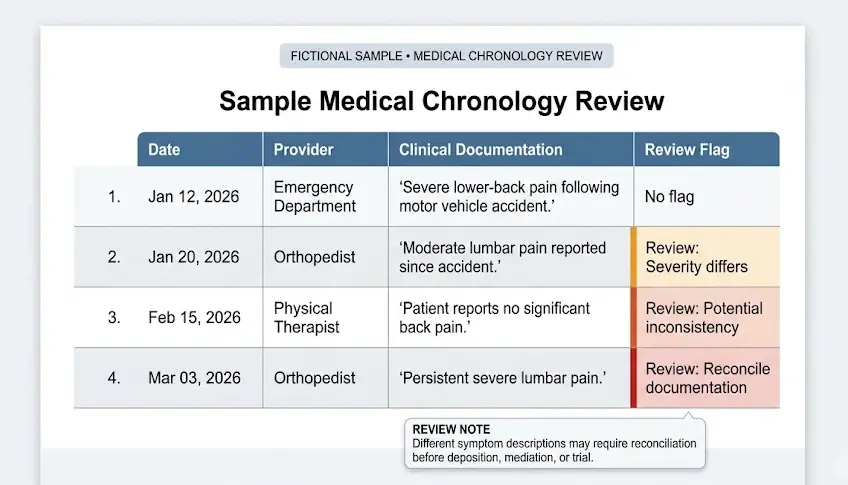
A structured medical chronology can reveal documentation inconsistencies that require investigation before opposing counsel identifies them.
Undocumented Treatment Gaps
A three-month gap between the incident date and the first related treatment, or a lapse between follow-up visits, is one of the most common tools defense teams use to argue an injury wasn't serious or wasn't caused by the incident at issue. Sometimes the gap has a legitimate explanation (insurance delays, provider availability); sometimes it reflects a genuinely missing record.
The Fix: Systematic gap analysis across the full chronology identifies every unexplained interval early enough for the attorney to investigate and, where needed, retrieve the missing documentation.

Billing and Coding Discrepancies
CPT and ICD-10 codes that don't match the corresponding clinical notes, or billing entries for procedures with no supporting documentation, raise red flags for insurers and can undermine a damages calculation. These mismatches are common when billing and clinical records are produced separately, which is the norm rather than the exception.
The Fix: Reconciling treatment records against itemized bills line by line confirms that every billed service has clinical support, and flags anything that doesn't.
Duplicate and Conflicting EHR Entries
Electronic health record systems make it easy to copy forward a prior note without fully updating it, which can leave outdated information, or even another patient's details, embedded in a current record. These artifacts create confusing, sometimes contradictory documentation that muddies an otherwise clear treatment history.
The Fix: De-duplication and cross-checking during review strips out redundant or erroneous entries so the working file reflects what actually happened, not an EHR copy-paste error.
Incomplete Retrieval From Every Treating Provider
The most consequential documentation error often happens before review even starts: records are requested from some providers but not others. Imaging centers, physical therapy practices, and referred specialists are commonly missed, leaving a record set with gaps that get misread as missed treatment rather than what they really are — records nobody asked for.
The Fix: End-to-end Medical Record Retrieval Services that track every provider referenced in the chart, not just the ones named in the initial request, ensure the record set attorneys review is actually complete.

Why Catching These Errors Early Matters
None of these errors are exotic. They are the ordinary byproduct of medical records passing through multiple providers, EHR systems, and billing offices before ever reaching a case file. The risk isn't that they exist, it's that they go unnoticed until a deposition, a mediation, or a defense expert report brings them to light on someone else's terms.
A disciplined process built around complete Medical Record Retrieval, thorough Medical Record Review , and specialized Personal Injury Medical Record Review, along with a clear Medical Chronology, turns these silent case killers into issues attorneys identify, explain, and control long before opposing counsel gets the chance to use them.
Once the records have been reviewed and the key evidence organized, that information can also support Drafting Demand Letters and other case-preparation tasks, helping attorneys present the medical evidence clearly and address potential weaknesses before settlement negotiations or trial.
LinksToValue supports US personal injury, medical malpractice, mass tort, and SSD practices with HIPAA-compliant retrieval, review, and chronology services built to catch documentation issues before they reach a courtroom. Contact our team for a free sample review of your next case file.
FAQs
Mismatched patient identifiers — variations in name spelling, date of birth, or Social Security Number across providers — are among the most common errors. They cause records to be misfiled, overlooked, or excluded, and can let defense counsel argue that a record doesn't belong to the plaintiff at all.
Yes. Gaps in treatment, inconsistent injury descriptions, or missing provider records can be used to argue that an injury is less severe than claimed, unrelated to the incident, or was inadequately treated, all of which affect settlement value and credibility at trial.
A structured medical record review that cross-references every provider, date, and billing entry against the full record set is the most reliable way to catch errors early, ideally during case intake or well before depositions and mediation.
Different providers use different EHR systems, document with varying levels of detail, and sometimes copy-paste prior notes forward without updating them. This creates inconsistencies in symptom descriptions, dates, and diagnoses that were never intended to conflict but read that way on paper.
An uncertified record lacks the custodian's certification confirming it is a true and complete copy of the original. Uncertified records can be challenged as inadmissible or unreliable, so attorneys should confirm certification status when records are retrieved, not after a challenge is raised.
If a request only reaches some of a patient's providers, the resulting record set will have built-in gaps. Those gaps then get misread as missed treatment or a lapse in care, when the real issue is that the records were never retrieved from every provider in the first place.
Yes. Dedicated review teams are trained to systematically flag missing signatures, coding mismatches, treatment gaps, and identity discrepancies across large record sets, catching errors that are easy to miss when review is squeezed between other case deadlines.
About the Author
Sugeet Wahal, Founder & CEO, LinksToValue
Sugeet Wahal founded LinksToValue to help US attorneys and law firms turn voluminous medical documentation into clear, litigation-ready evidence. He writes about medical-legal review, litigation support, and legal process outsourcing for independent attorneys and small to mid-size US law firms. Connect on LinkedIn.