

A hospital sends a searchable PDF. A specialist supplies a portal download. Physical therapy records arrive as scanned attachments. Everything is electronic, yet the attorney still cannot answer a basic question quickly: what happened, when, and where is the supporting record?
Electronic medical records make information easier to store and search. They do not automatically produce a dependable treatment timeline. Medical chronology preparation turns those separate records into a dated, source-linked account that a litigation team can check, update and use. For small and mid-sized US law firms, that discipline helps keep record organization from consuming the time needed for case analysis.
Even minor inconsistencies in dates, missing records, duplicate entries, or incomplete documentation can affect case preparation. Learn more about common documentation errors that can undermine litigation and how to identify them during medical record review.
What electronic records can hide
The terms electronic medical record (EMR) and electronic health record (EHR) are often used interchangeably. An EMR typically refers to a provider’s digital chart; an EHR is intended to support a broader, shared health history. For litigation teams, the practical question is what information the actual production contains.
A PDF export may include progress notes but omit attachments, separate billing records or relevant revision information. A patient portal download should not be assumed to contain everything a provider holds. Searchability also varies: a digitally delivered file can contain scanned pages that require optical character recognition (OCR). Start by checking scope and readability, rather than treating “electronic” as evidence of completeness.
Put the clinical event on the right date
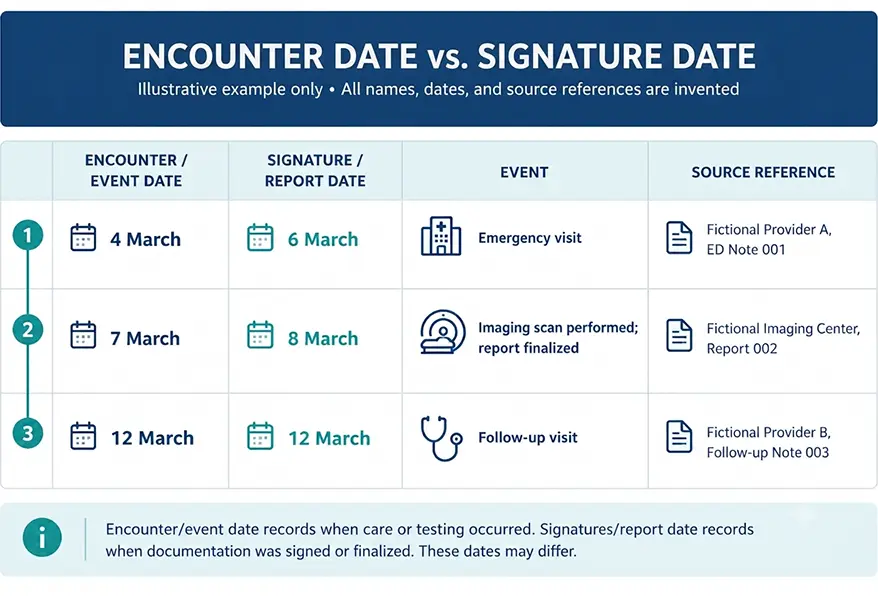
Electronic records can display several dates: the encounter, the note’s creation, the clinician’s signature and the export. Those dates describe different events. Sorting every page by the most prominent timestamp can place treatment in the wrong sequence.
For example, an emergency visit on March 4 may be documented in a note signed on March 6. The treatment belongs under March 4, with the later signature recorded separately if relevant. For an imaging study, distinguish acquisition from interpretation or amendment. When the record does not establish the event date, label the uncertainty instead of filling it with an assumption. Preserve original timestamps when time of day matters.
Recognize repeated text without losing evidence
Templates and copied-forward text can reproduce earlier symptoms, medication lists or examination findings. Repetition does not prove that a finding was reassessed at every visit, nor does it automatically establish a documentation error. Compare the entry with surrounding notes and identify material inconsistencies for further review.
Duplicates need similar care. Two visually similar documents may differ in a signature, an addendum or a corrected result. Remove exact duplicates from the working review set only after comparison, while preserving the original production and a record of what was consolidated. Never silently overwrite an earlier version because a later note appears more complete.
Build entries that another person can verify
A useful chronology entry identifies the service date, provider and facility; summarizes relevant complaints, findings, diagnoses, treatment and follow-up; and points to the original document. Include a stable source identifier, such as a Bates number or file name and page, alongside a hyperlink where available. Links can break when files move; written references keep the entry usable.
Separate patient reports from clinical observations and provider opinions. “Patient reported pain after the collision” carries a different meaning from a physician’s documented causation opinion. Preserve qualifiers such as “possible,” “rule out” and “history of.” An ICD-10 code alone should not be presented as proof of a confirmed injury or its cause.
Treat gaps as questions to investigate
A missing interval in the file is not necessarily a gap in treatment. A referral, follow-up plan or billing entry may point to care whose records have not been supplied. Maintain a missing-records list showing the provider, expected document and next action. Medical Record Retrieval Services can support that follow-up.
Reconcile clinical encounters with available bills, but keep charges, payments and adjustments distinct. A billed amount is not automatically the legally recoverable amount. The chronology should organize the evidence and flag differences; attorneys determine their significance under the applicable law and case circumstances.
Use a manageable workflow for a small firm
Begin with an inventory of providers, date ranges, file formats and production batches. Confirm patient identity, preserve originals and create searchable working copies when needed. Then review events across providers, resolve material duplication, and draft the timeline with source references. Medical Record Review Services support this underlying review; chronology presents its findings in sequence.

Before delivery, check key dates, laterality, medication doses and important findings against the actual pages. Add a separate issues list for unresolved questions. Record the chronology version and the production batches reviewed. When new records arrive, update affected entries and references rather than circulating several inconsistent timelines. Legal Coding and Indexing Services can help maintain consistent document organization.
Let technology assist and reviewers verify
OCR and AI can assist with locating dates, classifying documents and drafting summaries. Their output still needs verification: a missed “no,” a misread dose or a wrong date can change the meaning of an entry. Do not let an automated summary become a source of facts unsupported by the record.
The federal SAFER Clinician Communication guide recommends clinician validation of LLM-generated transition-of-care documentation before signoff. That is healthcare guidance, rather than a litigation rule, but it illustrates why human verification matters. Use firm-approved systems for confidential records, with access controls and appropriate contractual safeguards. Assess privacy obligations and vendor arrangements for the specific engagement.
Turn electronic documentation into usable case knowledge
LinksToValue’s Medical Chronology Services organize medical events with provider details, service dates, complaints, diagnoses, treatment, outcomes and billing summaries. Hyperlinked citations and bookmarks connect summarized facts to source pages. These features help attorneys move between the timeline and the underlying evidence without repeatedly searching the entire production.
A reliable chronology supports demand preparation, expert review and deposition planning while leaving legal judgment with counsel. Its value comes from an accurate sequence, transparent sources and visible uncertainties. For a closer look at how organized medical timelines support case outcomes, explore our Medical Chronology for Settlement Negotiations and Trial Preparation service. Contact LinksToValue to discuss your record set and request a free trial of its medical chronology services.
About the reviewer
Mr. Sugeet Wahal is the Founder and CEO of LinksToValue. This article is intended for review from a litigation-support and service-workflow perspective; the attribution does not imply medical or legal credentials.
Connect with Sugeet Wahal on LinkedIn
This article provides general information about record organization and litigation support. It is not medical advice or legal advice, and a chronology does not independently establish causation or admissibility.
Frequently Asked Questions
It is a dated account of relevant medical events assembled from digital charts, exports and scanned records, with references to the documents supporting each entry.
No. Completeness depends on the provider, system and scope of the production. Check date ranges, attachments, reports, bills and referenced providers rather than assuming an export contains every relevant record.
Use the documented clinical event or service date where established. Record signature, report and amendment dates separately when relevant, and identify uncertainty if the event date cannot be verified.
Compare repeated entries for material changes and contradictions. Consolidate verified duplicates in the working set while preserving the original production and significant versions or addenda.
AI can assist extraction and drafting, but its output should be checked against source records. Verify important dates, negations, doses, findings and citations before relying on a chronology.
No. The apparent gap may reflect missing documents or care from another provider. Check referrals, follow-up plans and available bills, and track unresolved retrieval requests.
LinksToValue organizes medical records into chronological entries covering providers, service dates, complaints, diagnoses, treatment, outcomes and billing summaries, with hyperlinked citations and bookmarks for source navigation.
Further reading
Federal SAFER Clinician Communication guide
LinksToValue Medical Chronology Services